# creed_machine_learning_bootcamp
location = "Fountain of Love RCCG, Aberdeen"
duration = "5 days"
audience = "Teenagers with no prior coding experience"
>>> bootcamp.start()
Everything you need for each day: slides, notebooks, and datasets.
# resources_by_day
What machine learning actually is, and what makes data useful.
Same dataset, two completely different approaches. 333 penguins from Antarctica: first with answers, then without.
Day 2 Reading Assignment
Man-Computer Symbiosis
Written in 1960, this paper predicted nearly everything we now take for granted about how humans and computers work together. Licklider imagined computers as partners that handle the routine, repetitive work so that humans can focus on the thinking that actually matters. Read this after Day 2 and ask yourself: which of his predictions came true, and which ones are still waiting?
Build, train, and deploy a real classifier from scratch using the CRISP-DM framework.
Day 3 Written Assignment
Why did the higher-scoring model lose?
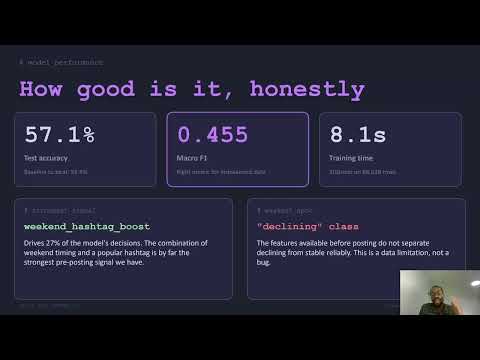
TrendCaster tested three models. Logistic Regression scored 63.7% accuracy, XGBoost scored only 57.1%, and yet XGBoost was chosen and Logistic Regression was called "unusable". Explain why the highest-scoring model lost, and what this teaches us about the sentence "my model is 90% accurate."
Five teams. Seven real problems. Four hours. By 13:30 your team will have a trained model, honest numbers, and a live app ready to pitch to judges tomorrow.
Today you are not students. You are founders. Finish your product, deploy it live, and pitch it to the room.
# recap_videos
# part_01
Welcome to ML and Data
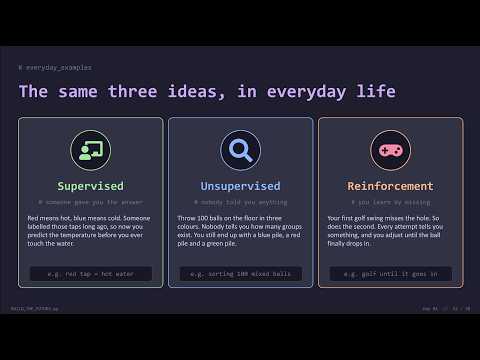
What machine learning actually is, why data is the fuel, and the three types of learning. The session that set the foundation for the whole week.
Watch on YouTube
# part_02
Supervised Learning
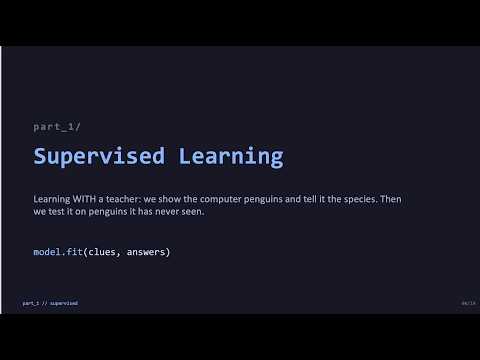
Training a Decision Tree on 333 real penguins from Antarctica. Features, labels, train/test split, accuracy, and the confusion matrix explained.
Watch on YouTube
# part_03
Unsupervised Learning
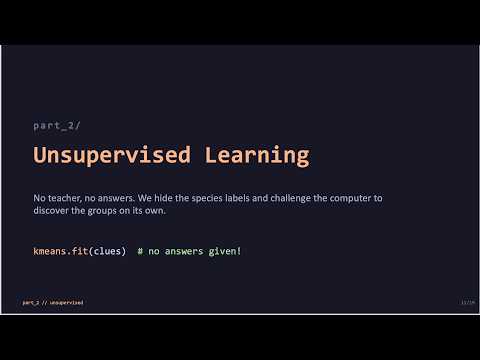
Same penguins, no labels. K-Means clustering, the elbow method, silhouette score, and the reveal: did the computer rediscover the 3 species on its own?
Watch on YouTube
# part_04
TrendCaster
A full ML project from scratch. CRISP-DM, data leakage, SMOTE, three models compared, XGBoost selected, and the model deployed as a live app.
Watch on YouTube# part_05 / day_04
The Startup Challenge
Five teams, five real-world datasets, one day. Claude Code, Gradio deployment, and pitching your MVP to the room. The full challenge recap.
Coming soon# extra_learning
# extra_01
Cleaning Messy Data
Real-world data is never clean. Missing values, outliers, wrong types, duplicates. The techniques every ML practitioner uses before touching a model.
Coming soon# extra_02
Regression Analysis
Predicting numbers rather than categories. When to use regression, how to evaluate it, and what the residuals are telling you.
Coming soon# lightning_talks
# lightning_01
What It Is Like Working With Data
Tobi Kasali
Tobi Kasali shares what a real career in data actually looks like, the challenges, the skills, and what no one tells you before you start.
Watch on YouTube
# lightning_02
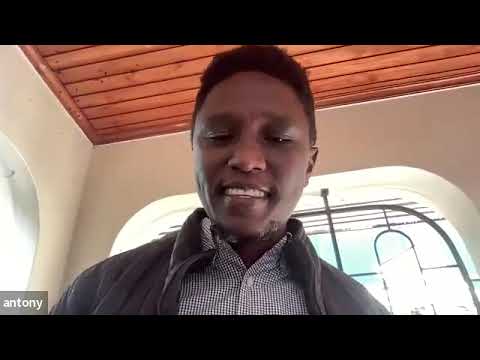
What It Is Like Working at Google
Antony Kaguara
Antony Kaguara takes the bootcamp students inside one of the world's most recognised tech companies and what it takes to get there.
Watch on YouTube
# lightning_03
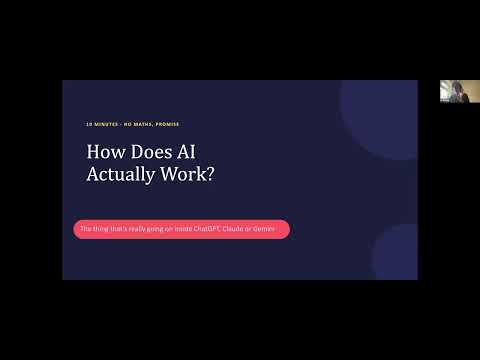
How AI Actually Works
Dr Regina
Dr Regina breaks down the mechanics behind artificial intelligence in a way that makes the technology feel accessible and real.
Watch on YouTube

# lightning_04
How to Pitch Your Project
Dr Rotimi Alabi
Dr Rotimi Alabi walks through what makes a pitch land, from structuring your argument to standing in front of judges with confidence.
Watch on YouTube
# event
Celebrating Our Participants
CREED Aberdeen
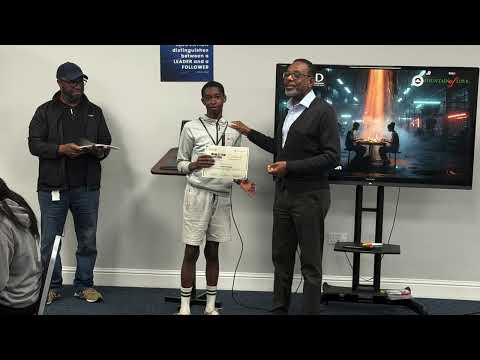
The moment the bootcamp had been building to. Certificates presented to every young person who showed up, built something, and saw it through.
Watch on YouTube# ai_glossary
Machine Learning
Teaching a computer to find patterns in data so it can make decisions without being told every rule. Instead of programming the answer, you show it examples.
Algorithm
A step-by-step set of instructions a computer follows to solve a problem. Every model runs on an algorithm under the hood.
Model
The thing an ML system produces after learning from data. You feed it new inputs and it returns a prediction. The model is what gets deployed.
Training
The process of showing a model lots of labelled examples so it can learn the patterns between inputs and outputs. Training only happens once; prediction happens forever after.
Feature
A piece of input information the model uses to make its prediction. For a song: tempo, energy, danceability. For a video: platform, category, creator tier.
Label
The answer the model is trying to predict. "Hit or flop." "Pass or fail." "Rising, stable, declining, or seasonal." Labels are what you give the model during training.
Supervised Learning
Training where you give the model both the inputs and the correct answers. The most common type of ML. Used whenever you have labelled historical data.
Unsupervised Learning
Training with no labels. The model finds structure on its own by grouping similar things together. Used when you do not know what categories exist yet.
Classification
Sorting inputs into categories. Spam or not spam. Trending or declining. Pass or fail. When the output is a named category, it is a classification problem.
Regression
Predicting a number rather than a category. "What score will this student get?" or "How many views will this video get?" When the output is continuous, it is regression.
Accuracy
The percentage of predictions the model got right. Sounds simple, but misleading when one class is much more common than the others. Always check the confusion matrix too.
Confusion Matrix
A grid that shows exactly where a model's predictions were right and where they went wrong. Rows are the real answers. Columns are what the model predicted. The diagonal is correct.
Overfitting
When a model memorises the training data instead of learning general patterns. It scores brilliantly on data it has seen and fails on anything new. The ML equivalent of cheating on a practice paper.
Bias in AI
When a model systematically favours or penalises certain groups, usually because the training data did not represent everyone equally. A model trained mostly on one demographic makes worse predictions for everyone else.
Neural Network
A type of model loosely inspired by how the brain connects neurons. Powerful for images, speech, and language. The foundation of most modern AI you interact with daily.
Large Language Model (LLM)
The type of model behind ChatGPT, Claude, and Gemini. Trained on enormous amounts of text to predict what comes next. That prediction loop, done billions of times, produces what feels like conversation.
Data Leakage
Using information during training that would not actually be available at prediction time. The model looks brilliant in testing but useless in the real world. One of the most common and costly ML mistakes.
Clustering
Grouping similar examples together without being told what the groups should be. K-means is the classic algorithm. Used to find natural structure in data before you know what to look for.
Precision and Recall
Two measures that matter when one type of mistake is worse than another. Precision: of the things the model flagged, how many were real? Recall: of all the real ones, how many did the model catch?
CRISP-DM
A six-phase framework for running ML projects: understand the business problem, understand the data, prepare the data, build the model, evaluate it, then deploy. Used by professionals worldwide.
# share_your_experience
Anonymous. No names, no pressure. This takes about three minutes and helps us make the next bootcamp even better.
# no name required. all responses go to creed.aberdeen@gmail.com
# meet_the_team
Dr Oluwaseun Olabode
Lead Instructor
Oroboade Ayodeji Johnson
Volunteer Instructor
Queen Akindele
Volunteer Instructor